
How to Understand Fast Native English Speakers
12 October 2026 · why is native english so hard to understand · how to train your ear for fast english · connected speech listening practice · fast English
By the end of this guide, you will be able to take an unfiltered, rapid sentence from any native YouTube speaker and dissect every collapsed syllable until the entire thought sounds slow, separated, and instantly clear.
The Mechanics Behind Collapsed Speech
You can learn English grammar using our free platform
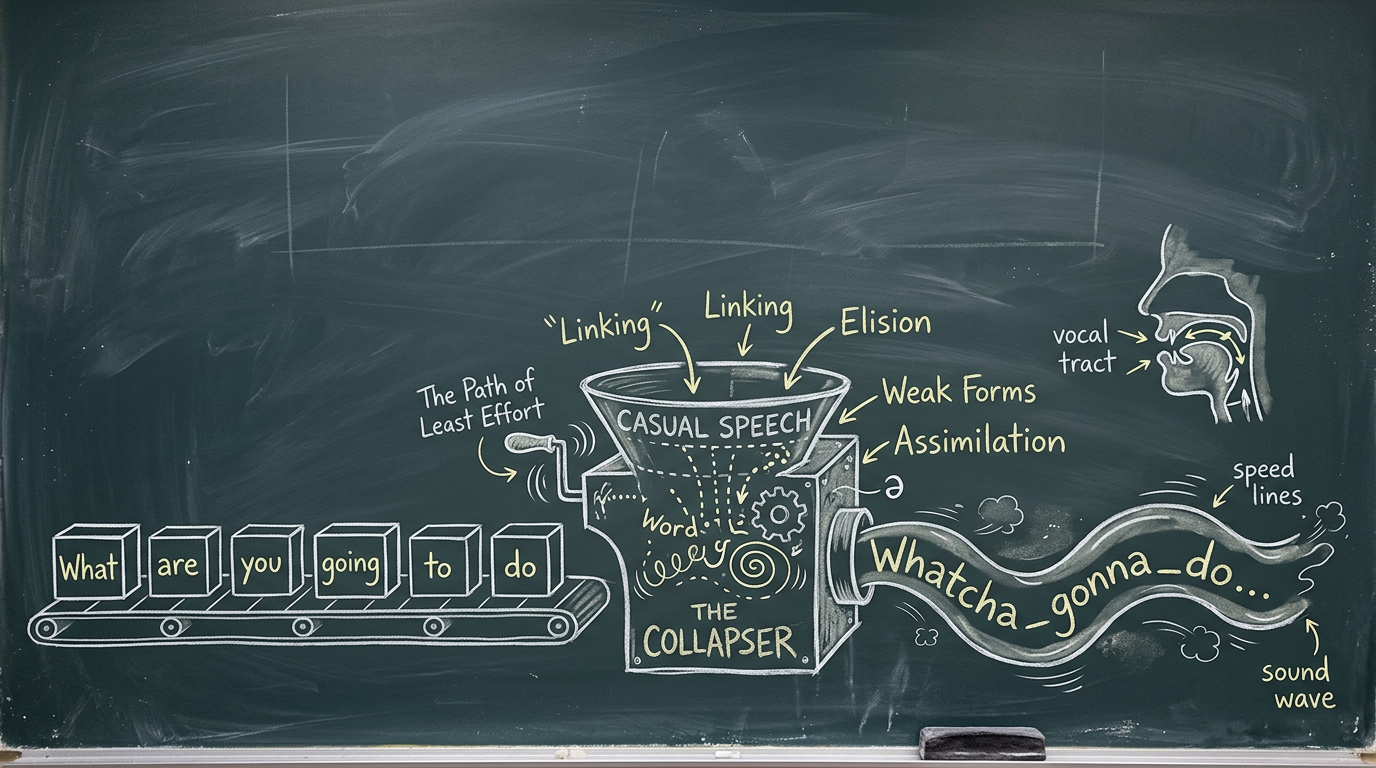
If you have ever asked yourself why is native english so hard to understand, the answer rarely lies in advanced vocabulary. Most learners at the B1 or B2 level already know eighty percent of the individual words in any conversational vlog or interview. The obstacle is that natural speech does not work like a printed book. When native speakers talk quickly, they do not pronounce words as isolated units with crisp borders. Instead, their vocal cords, tongue, and lips take the path of least physical effort, merging sounds into continuous streams.
Linguists call this phenomenon connected speech. To master how to understand fast english, you must recognise four primary sound modifications that occur whenever someone speaks at a standard conversational tempo:
- Linking: Consonants glide into following vowel sounds. A phrase like "hold on a minute" becomes "hol-do-na-minute". The physical boundary between the words disappears entirely.
- Elision: Unstressed sounds vanish to speed up articulation. In the phrase "next door", the /t/ is omitted, leaving "nex-door". Similarly, "sandwich" commonly drops the /d/ to become "san-wich".
- Weak Forms: Structural words such as *to*, *for*, *can*, and of change their vowels into a neutral schwa (/ə/). You rarely hear "I can go to the store" pronounced with full dictionary vowels; it sounds like "I k'n go t' th' store".
- Assimilation: Adjacent sounds influence each other and morph into an entirely new sound. When a word ending in /t/ or /d/ meets a word beginning with /j/ (a "y" sound), they blend. "Don't you" transforms into "don-choo", and "did you" becomes "did-joo".
Consider how these rules combine in a single mundane phrase like "What are you going to do with that?". In casual speech, "what are you" assimilates and weakens into "whatcha" or "wot-cher", "going to" collapses into "gonna", and the preposition "with" often links directly into the demonstrative pronoun "that", dropping the crisp dental fricative at the boundary. The resulting acoustic package sounds like "Whatcha gonna do wid-dat?". If you listen for seven distinct dictionary entries, the sentence sounds like an impenetrable dialect. Once you break down the weak forms and assimilation points, however, you recognise that the speaker has not used slang; they have merely obeyed the natural rhythmic rules of English phonology.
When your brain searches for textbook pronunciation, it fails because the acoustic input does not match the stored spelling in your memory. You are expecting five clear blocks of sound, but the speaker produces one blended acoustic wave. Recognising these sound adjustments converts random mumbling into systematic rules you can easily decipher.
Training the Ear with Synchronised Text
You can learn English grammar using our free platform
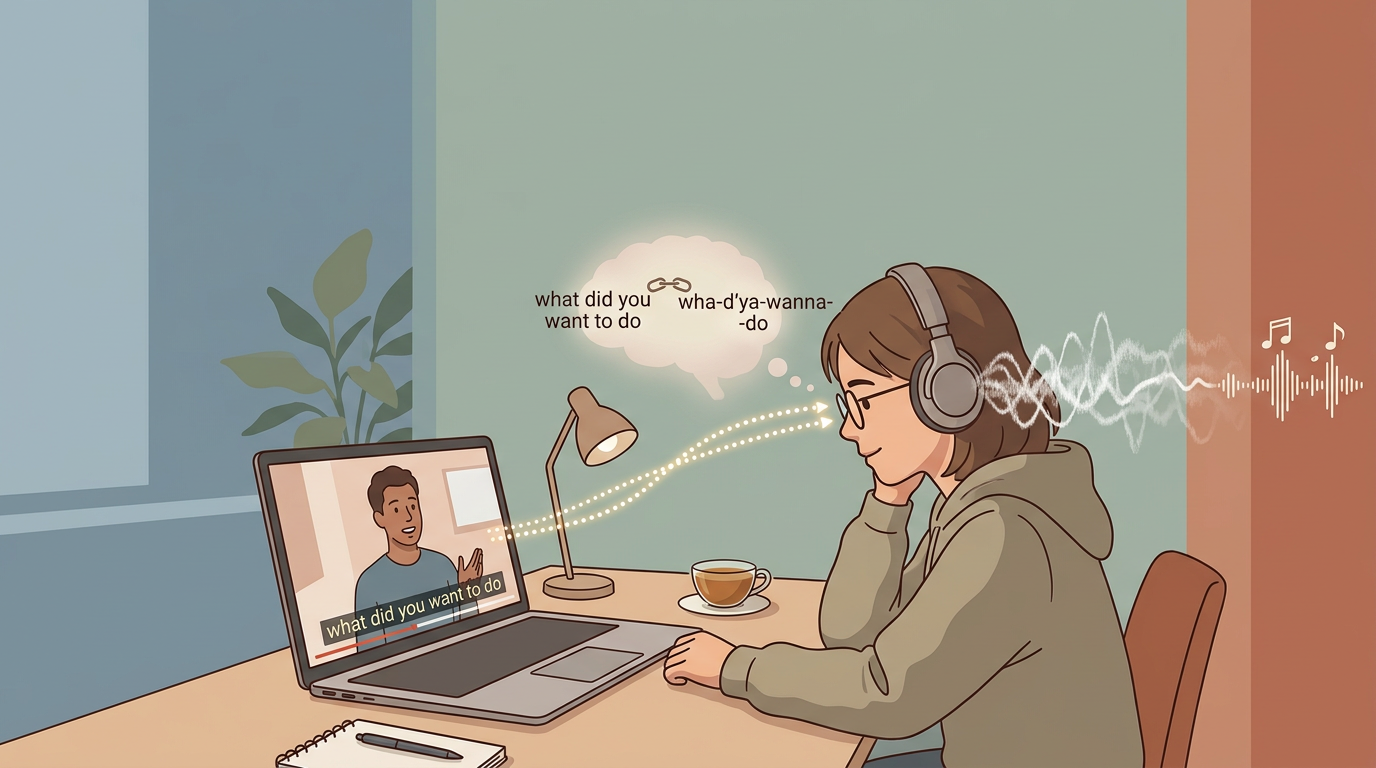
Many learners believe they should turn off subtitles completely to force their ears to work harder. In reality, switching off text when you cannot comprehend the audio only reinforces confusion. If your ear hears an unfamiliar acoustic blur and receives no immediate visual clue, the brain simply discards the data. You cannot decode a sound pattern if you never verify what was actually uttered.
Reading synchronized text alongside authentic audio creates dual-coding in the brain. When you look at the exact words at the precise millisecond you hear them, your visual cortex assists your auditory cortex. You begin to connect the visual spelling "what did you want to do" with the spoken reality "wha-d'ya-wanna-do". Over time, this trains your mental dictionary to store both the formal written spelling and its spoken counterpart.
This is why interactive video players make a dramatic difference to your listening speed. Platforms like vidvocab display real-time interactive captions alongside native YouTube clips. Instead of guessing through a muddy stream of syllables, you see the exact transcript aligned with the voice track. You can tap on a word instantly to see its definition, review its weak form, and verify how the speaker compressed the syllable.
Ensure, however, that you avoid automated captions that lag behind or drop words. Imprecise subtitles teach incorrect sound pairings. You need precise transcripts that accurately display every hesitation, contraction, and colloquial phrasing. Once your mind observes the correlation fifty times across different contexts, your auditory system begins decoding the stream automatically without relying on the transcript.
The Ten-Second YouTube Loop Drill
You can learn English grammar using our free platform
Passively listening to an hour-long podcast does not teach your auditory system how to unpack blended sounds. To learn how to train your ear for fast english, you need deliberate, micro-level repetition. This four-step drill isolates rapid speech segments so your brain can process phonetic shifts.
Open a YouTube video featuring two native speakers having an unscripted conversation—such as a podcast interview or a casual lifestyle vlog. Avoid formal news broadcasts, as news presenters deliberately use clear enunciation rather than real conversational phonetics. Work through the following stages:
Step 1: Select and Loop a Ten-Second Clip
Find a moment where a speaker talks quickly and you lose track of the sentence. Set your video loop to repeat those ten seconds continuously. Listen to the clip three times in a row at normal speed without checking the transcript. Try to identify which words carry the main stress and which sections sound like pure murmur.
Step 2: Transcribe What You Hear
Take a blank notepad and write down every single word you catch. Do not guess the grammar yet; simply write down the sounds you hear phonetically if you cannot identify the word. This exposes the gaps in your auditory perception. You will quickly notice whether you struggle with dropped consonants or weak prepositions.
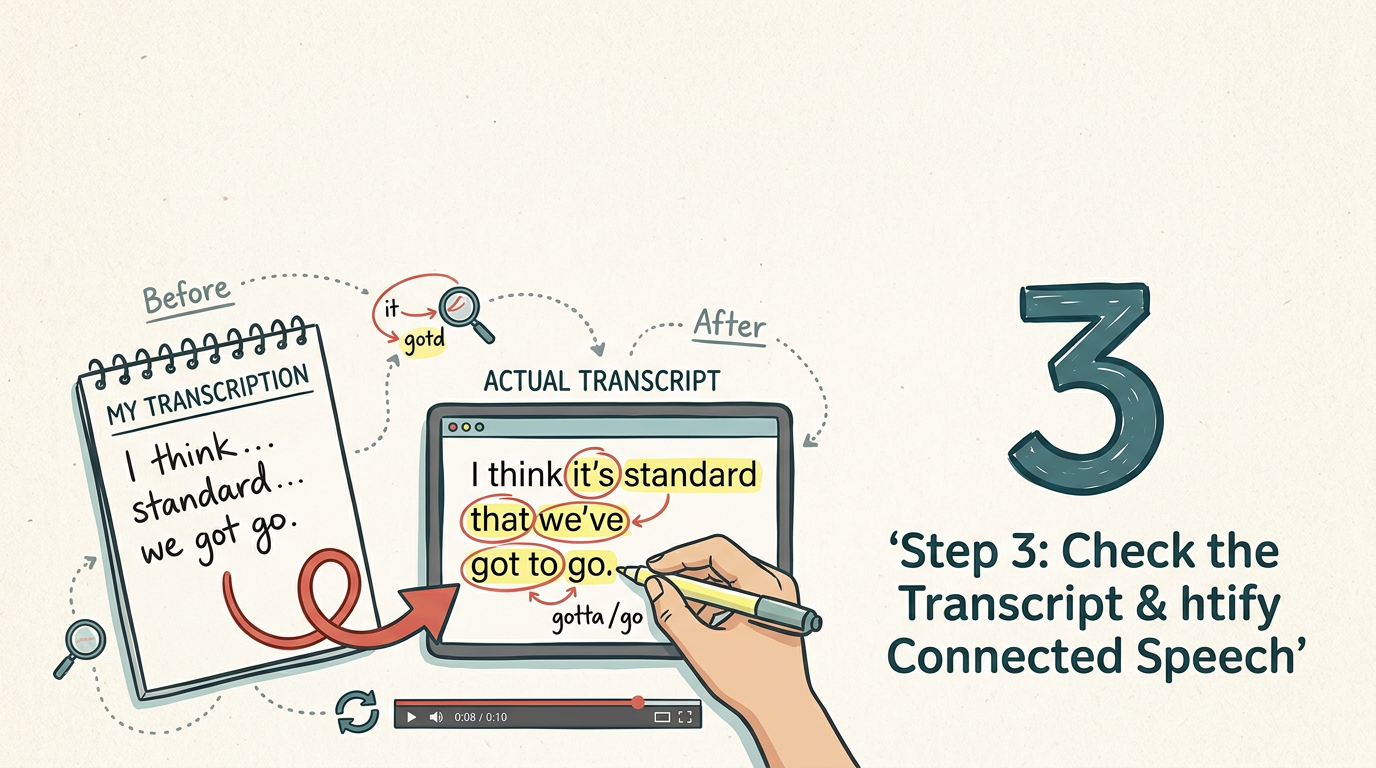
Step 3: Check the Transcript and Identify Connected Speech
Reveal the subtitles or inspect the text. Compare your written notes to the actual words. Highlight where you missed a word and ask yourself why: Did the speaker link a consonant to a vowel? Did a preposition turn into a schwa? Underline the phonetic bridge where two words merged together.
Step 4: Shadow the Clip at Full Speed
Play the loop again and speak aloud simultaneously with the native speaker. Match their rhythm, elisions, and contractions. If you cannot produce the sound physically with your mouth, your ear will struggle to recognise it when someone else speaks it. Once you can speak the ten-second phrase at full speed without stumbling, move on to the next clip.
Spend fifteen minutes on this exercise rather than spending an hour passively watching full episodes. Quality repetition builds neural connections far quicker than broad, unfocused exposure.
Daily Practice for Effortless Comprehension

You can learn English grammar using our free platform
Isolated practice sessions only deliver lasting results if you integrate them into a sustainable routine. Many learners try to study for three hours on a Saturday afternoon, burn out, and avoid listening for the rest of the week. Auditory processing adapts through short, daily exposures rather than sporadic weekend marathons.
Dedicate twenty minutes each day to connected speech listening practice using your phone. The ideal routine fits naturally into a morning commute or a midday break. Consistency is simple when you focus on one engaging clip every single day:
- Minutes 1–5: First Impression. Watch a two-to-three-minute video once from start to finish without pausing. Focus on capturing the main story or message without worrying about individual missing syllables.
- Minutes 6–12: Micro-Analysis. Pick the single most challenging segment from the video—roughly fifteen to twenty seconds long. Use the looping drill outlined above to dissect every dropped letter and linked vowel.
- Minutes 13–18: Vocabulary and Grammar Review. Check the unfamiliar phrasal verbs or slang used in the segment. In the vidvocab blog, we regularly highlight how native speakers pair informal phrasal verbs with weak pronouns to create lightning-fast contractions.
- Minutes 19–20: Final Fluid Playback. Watch the entire clip one final time with captions turned off. You will notice that the muddy, confusing section now sounds completely articulate and paced.
Avoid the common mistake of slowing the video playback speed down to 0.75x permanently. While slowing the audio can help you diagnose an elusive consonant, leaving the speed reduced prevents your brain from adapting to natural cadence. Always return the video to 1.0x speed to finish your practice session.
A common mistake during daily practice is switching video genres too frequently. If you watch a gaming commentary on Monday, an architectural lecture on Tuesday, and a culinary vlog on Wednesday, your ear has to adapt to entirely new background noises, speaking cadences, and specialist terminologies every single day. Instead, pick a single content creator or podcast series and stick with them for a full fortnight. Familiarity with one speaker's individual voice, accent, and speech quirks reduces cognitive load, allowing your brain to concentrate exclusively on the phonetic links rather than decoding unfamiliar vocal acoustics.
After three to four weeks of this focused daily work, your listening experience will transform. Native conversations that previously sounded like an impenetrable blur will break down into obvious, recognisable word groupings, giving you effortless comprehension whenever you watch English media.